Is a smart stroller worth it?
For many families, a smart stroller is worth it because it combines safety, physical support, and multiple baby essentials into one system—reducing daily strain, improving accessibility, and simplifying routines. BUT the smart stroller experience is often worth more than the simple sum of its parts.
What is a smart stroller?
A smart stroller is a stroller with built-in technology—such as motor assistance, automatic braking, sensors, and app connectivity—that actively supports parents during everyday use.
Unlike traditional strollers, which rely entirely on manual control, a smart stroller is designed to respond to its environment and assist with movement, safety, and comfort.
Read more in our Complete Smart Stroller Guide
What you’re really paying for
The value of a smart stroller is not just in individual features. It’s in how those features work together.
It’s less about adding technology—and more about removing friction, removing time and effort spent on tasks that do not add to the connection to a baby.
1. Built-in safety and peace of mind
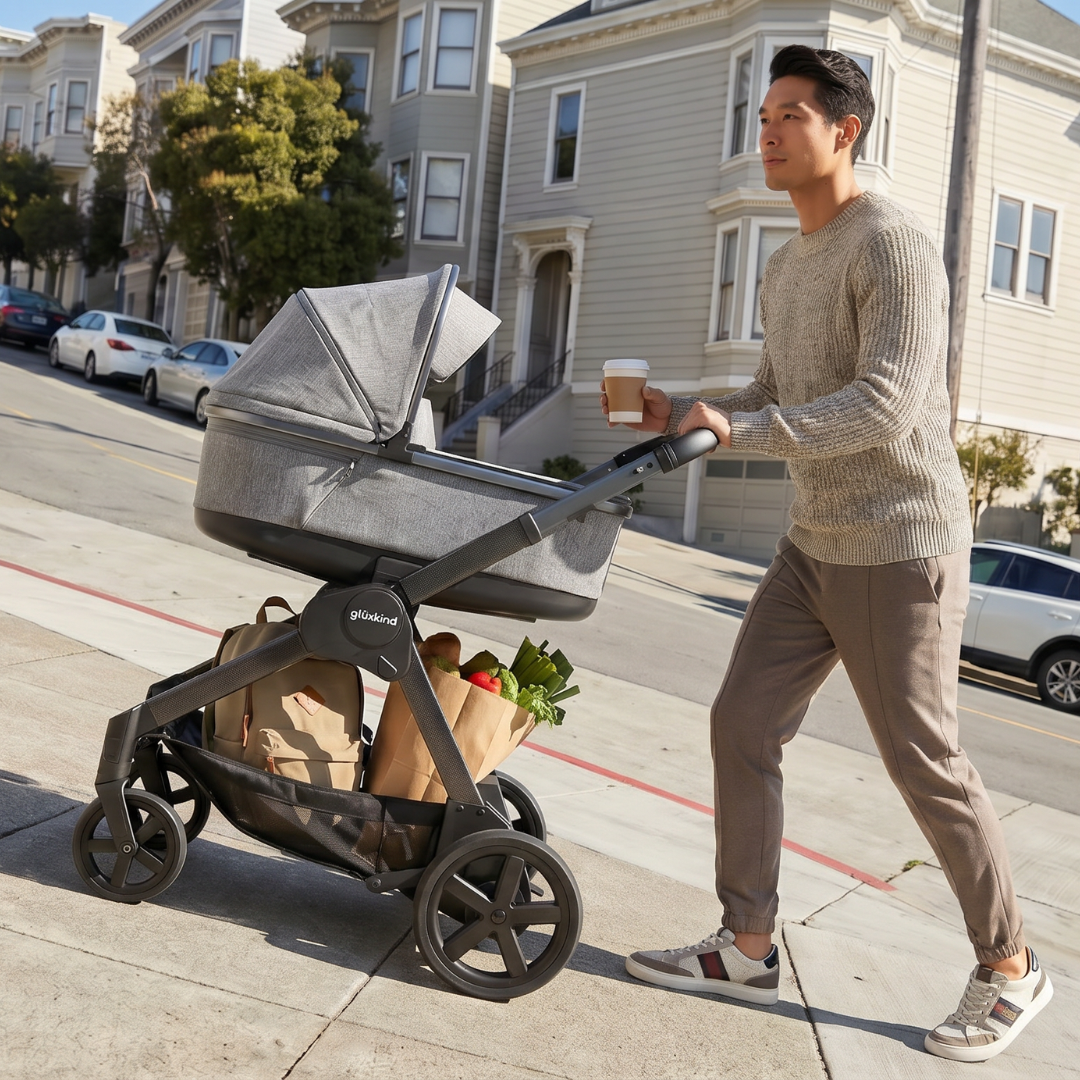
Early parenthood comes with constant background thinking:
What happens if I slip on this hill?
Can I trust grandma to take the stroller on longer walks?
What if my dog pulls me away from the stroller?
Am I in full control?
Smart strollers are designed to reduce those “what ifs.”
Features like:
automatic braking on slopes
controlled downhill speed
power assistance uphill
sensor-based stability monitoring
manual override at all times
…add a layer of support in real-world situations.
This doesn’t replace attention or care. It reinforces it and shares the load - quite literally.
For many parents, that added confidence is one of the most valuable aspects.
Glüxkind customer statement: “If my goal is to get the safest stroller currently available, why would I get anything other than the Glüxkind smart stroller?”
2. Less physical strain, more consistency

Pushing a stroller is constant, physical work—especially in cities, on hills, or over longer distances.
Motor assistance helps:
reduce effort uphill
maintain smoother movement
enable even hands-free movement (together with other sensors)
prevent fatigue over time
The benefit may not feel dramatic in a single moment. It’s cumulative.
Less strain means:
more consistent routines
less muscle fatigue and injury
fewer adjustments throughout the day
more energy at the end of it
Glüxkind customer statement: “I ended up walking much further with the Rosa stroller because it was less exhausting. Some trips I wouldn’t have attempted with the stroller before, now I don’t have to use the car.”
3. More inclusive for different physical needs
Not every parent starts from the same physical baseline.
Smart strollers can make everyday movement more accessible for parents with:
limited grip strength (very common during pregnancy and postpartum)
reduced core stability
joint pain or recovery from birth
temporary or long-term mobility limitations
Motor assistance reduces the force required to push.
Braking systems reduce the need for he user to be the only safety net on declines.
Stable movement reduces strain on the body.
For some parents, this shifts a stroller from something that is physically demanding or impossible to handle independently…to something that is manageable and even enabling.
It can mean:
longer, more comfortable walks
greater independence
less reliance on others for support
Accessibility is not always the primary purchase driver—but for many families, it becomes one of the most meaningful benefits. A product that is designed with accessibility in mind, is usually more convenient for everyone.
The Glüxkind perspective:
Multiple times, couples have reached out to us to discuss features and availability of our smart strollers in their region as they would not be able to manage daily life with a newborn without more considerate tools like our smart stroller due to disabilities and mobility limitations. We believe every parent should be empowered to explore the world with their little ones and we feel grateful that we can support parents on this journey.
4. Small moments to reset
Time looks different with a newborn. It’s the question “what were we doing all day before we had a baby?” that parents often ask themselves.

There are fewer breaks, fewer pauses, and less space to reset or connect as a couple.
When a stroller can:
gently rock a baby
maintain steady movement
create a peaceful and steady environment
reduce the need for constant input
…it creates small windows where parents can pause.
Not step away—but reset.
That might mean:
taking a deep breath
spending important 1:1 time with an older sibling
catching up on tasks at home
enjoying uninterrupted couple time
These moments may feel subtle, but they add up to something meaningful:
more patience, more presence, and more energy to engage.
Glüxkind customer story: A Glüxkind family really enjoyed the fact that they didn’t have to be nap trapped at home while ensuring that their baby gets predictable, extended naps. They used nap time for middle of the day dates and had the stroller rocking on patios while enjoying one on one time as a couple.
5. Fewer products, simpler setup

Traditionally, families purchase many items beyond the stroller:
rocker
mini crib
white noise device
mosquito nets
various accessories and add-ons
A smart stroller integrates many of these functions into one system - it’s not designed for expansion but for inclusion.
That means:
less to carry
less to set up
fewer transitions between products
fewer things to remember as you leave the house
Simplicity and the convenience of “all in one” are a big part of the value.
Read more about Glüxkind’s approach to sustainability.
Glüxkind perspective:
Part of our mission is to reduce the need to research products, evaluate options and constantly make decisions. We rather have parents get the big decision out of the way before baby arrives and give you a lot of the tools and features you will most likely purchase separately if you go the traditional stroller route. Glüxkind is German for lucky child but also has a metaphorical meaning of everything will be fine. Glüxkind families already have the tools at their disposal that support a seamless transition into parenthood.
6. Supporting independence across caregivers
A stroller is rarely used by just one person.
For many, grandparents play an active role—but traditional strollers can be physically demanding or require constant attention, especially on hills or uneven terrain.
Smart strollers can make independent walks more accessible and comfortable for older caregivers.

Features like:
motor assistance to reduce pushing effort
Self braking to avoid rollaway strollers
Automatic slow down on hills
…help reduce the physical and mental load.
This can give grandparents:
more confidence to go out on their own
a greater sense of purpose and involvement
the ability to spend meaningful time with their grandchild independently
For parents, it creates flexibility.
It can mean:
fewer situations where additional help is needed
less reliance on external childcare
more opportunities to take a break, recharge, or focus on other responsibilities
The benefit extends beyond convenience. It strengthens the support system around the family—making caregiving more shared, more inclusive, and more sustainable.
7. Long-term value vs upfront cost
Smart strollers typically come at a higher upfront price.
The trade-off is:
reduced need for additional products
extended functionality over time
a more supported daily experience
The question becomes less about price—and more about how often those benefits are used.
Who is it most worth it for?
A smart stroller tends to deliver the most value for:
Parents in urban or hilly environments
Families with more than one child
Parents who walk frequently
Parents recovering postpartum
Parents who juggle care work solo, frequently
Caregivers with mobility or strength limitations
Those looking to simplify gear and routines
Read real life stories from Glüxkind parents here.
Is a smart stroller worth it?
A traditional stroller meets basic needs.
A smart stroller is designed to actively support daily life.
For parents balancing physical demands, safety concerns, and limited time, that shift can make a meaningful difference—not just in convenience, but in confidence, accessibility, and overall wellbeing.
Read more in our Complete Guide to Smart Strollers
FAQ
Is a smart stroller better for parents with mobility limitations?
It can be. Features like motor assistance and automatic braking reduce physical effort and improve control, making daily use more manageable.
Do you need a smart stroller?
Not necessarily. But for parents navigating more complex physical or environmental challenges, the added support can be valuable.
Is it worth the price?
For many families, the combination of safety, support, accessibility, and consolidation justifies the investment over time.